In the dark depths of winter around the equinox there are still plenty of fresh foods in season for those who don’t go along with the globalised production schedules and marketing of Agribusiness and find the idea of, say, runner beans and raspberries flown in from Egypt or South Africa in December rather obscene. Now is the time for brassicas and root vegetables, and the time for unheralded celery to take centre stage.
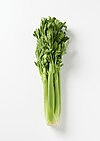
Crisp, fibrous sticks of celery are a blessing in mid-winter whether munched raw, thinly sliced into slaws with apple, onion and cabbage, blitzed into soups, or as one of the ‘holy trinity’ (along with carrot and onion) that constitute the soffritto foundation of so much Italian cuisine and the mirepoix base of countless French dishes. Celery, with its unique earthy, bitter-sweet tang, is an essential presence all year round in any home where cooking has not been consigned to ancient history by sad dependence on junk food deliveries and takeaways. In high summer the stalks are bright green but at this time of year it is the frost-resistant pale-green/white stalked variety that is available.
Apium graveolens is native to the salt marshes of the Mediterranean coast, where the biennial plant grows wild on islands and inter-tidal estuaries. Cultivated in Greece and Egypt as a vegetable and medicinal herb for at least 2,500 years, it gradually spread across Europe until by the 17th century it was being grown in the British Isles and had acquired its English name (from the French céleri derived from the Greek selinon meaning parsley) and also its Welsh name helogan, from the same etymology as halen meaning salt.
The problem with celery for people like me who like to grow a lot of their own food is that it is one of the trickiest of all vegetables to cultivate successfully. I tried repeatedly when I had an allotment at Pengam, but to no avail. It’s a demanding plant that needs a lot of attention more or less daily throughout its long growing season, requiring deep, fertile, moist soil boosted with generous amounts of compost, a big, sunny site with no adjacent competitors, copious watering and feeding, and regular inspections to remove slugs, spot a multitude of pests and diseases and deal with split stalks and suckers. Modern varieties have eliminated the traditional labour-intensive practice called ‘blanching’ of growing celery in trenches and earthing-up the stems in order to lengthen and reduce the stringiness of the stalks and to improve the flavour. But these self-blanching varieties are feeble and bland, so serious celery growers wanting crispness and flavour still have to protect the stalks – a fiddly hassle usually done nowadays with brown paper. Lacking the infinite patience, the manual dexterity and the grim resolve this chore necessitated, I gave up growing the buggers after two summers (spuds, courgettes and lettuces were so much easier). There was no alternative: if I wanted celery that meant the supermarket.
The trouble with UK supermarket celery is the same as the trouble with UK supermarkets: they’re crap. The primacy of shareholder dividends and profit margins, the ‘just in time’ production schedules, the ever-shrinking shelf lives, the race-to-the-bottom sacrifice of quality on the altar of cheapness and the resulting homogenised, tasteless end product drenched in pesticides has only been made worse post-Brexit as the European labour that lifted the plants in autumn and winter has disappeared and the care and attention celery needs when being harvested has been cut back severely, meaning jobs like power-hosing to rid the ridged stalks of soil have been abandoned and the plants are sold clogged with dirt. As a result UK celery production has greatly diminished since Brexit and now most is flown in from Spain, where at least the stalks are cleaned properly. Celery could be grown commercially in Wales, particularly in the mild, wet south, but first our land use, agriculture and economy would have to be unshackled from the deathly grip of the British State.
Apart from the scrumptious stalks, celery’s peppery green leaves are a great addition to soups and salads and the ‘seeds’ (actually tiny fruits that only develop in warm climates) when ground into powder make ‘celery salt’, a delicious savoury seasoning and one of the key components of the bloody lovely cocktail Bloody Mary. But the very best part of celery is surely the knobbly, swollen root of its sibling celeriac (Apium graveolens var. rapaceum). In season in winter, celeriac makes an intensely tasty, silky soup.
I’ll end with a true story. A couple of weeks ago I popped into the local Co-op to buy celery, which it usually stocks. The small area devoted to fresh veg was being restocked and was entirely hidden behind a tall trolley, so I asked the worker filling the shelves if there was any celery. She replied “I don’t know love, what does it look like?” My heart sank. How the hell do I answer that? I was reminded of the old Oscar Wilde aphorism: There is no sin except stupidity…
Picture: Wikipedia