The 1851 ‘Great Exhibition’, organised by Prince Albert (1819-1861) and civil servant Henry Cole (1808-1882), was held at London’s Hyde Park in the ostentatious ‘Crystal Palace’ designed by Joseph Paxton (1803-1865). Six million people thronged to visit the panoply of exhibits in the enormous glass building. The edifice, dismantled after the Exhibition ended and then re-erected in 1854 in Sydenham, south London, was eventually destroyed by fire in 1936.
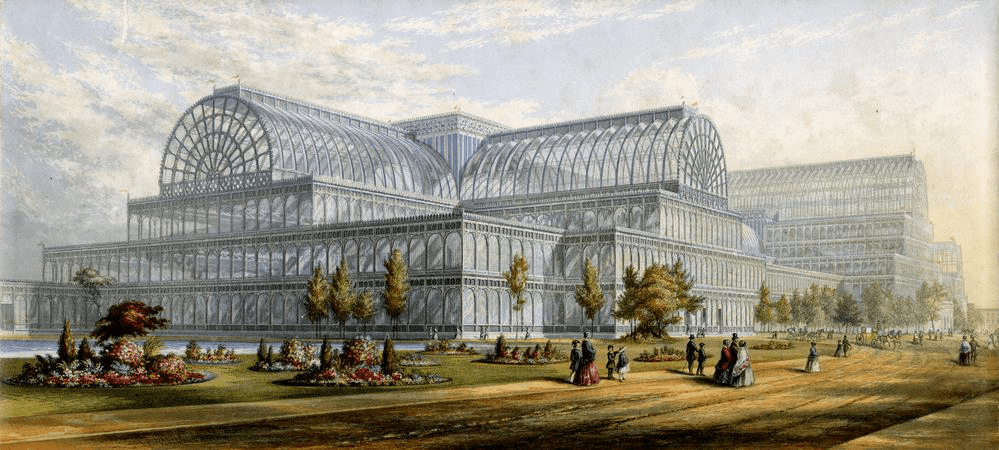

The bombastic extravaganza started a fashion for countries all over the world to hold similar self-congratulatory celebrations of their industrial, technological and cultural achievements. Usually called an ‘Expo’ (or a ‘World Fair’ in the USA), their heyday was in the late 19th and early 20th centuries. Most were soon forgotten and only the Eiffel Tower, designed by the construction firm of Gustave Eiffel (1832-1923) and erected in Paris for the 1889 ‘Exposition Universelle’, survives today as a noteworthy legacy of the global epidemic of tub-thumping exhibitionism – unless one counts Judy Garland (1922-1969) at her peak in MGM’s classic 1944 movie Meet Me in St Louis, set amid the 1904 St Louis World’s Fair.
With hindsight, the deliriously vulgar blend of trade show, funfair, circus, museum and mass marketing that distinguished all the countless exhibitions – from Adelaide to Berlin, Antwerp to Buenos Aries – can be seen as an early manifestation of the voracious, demotic, hard-sell consumer capitalism that has subsequently straddled the planet. Cardiff got in on the act in 1896 when the Council, urged by coal barons, shipping magnates and vainglorious industrialists, persuaded the 3rd Marquis of Bute (1847-1900) to permit the use of what was then privately-owned Cathays Park for the ‘Cardiff Fine Art, Industrial & Maritime Exhibition’. This was actually the third attempt at an industrial exhibition in Cardiff, following two minor events held in 1870 and 1881 at the Drill Hall in Dumfries Place (built in 1867 between the Taff Vale Railway and St Andrews Church, the Drill Hall was demolished in 1978 to make way for the Dumfries Place/Stuttgarter Strasse dual carriageway racetrack – hideous Dumfries House and Marchmount House, both perpetually half empty, occupy its former position).
Lasting six months, the Exhibition attracted 900,000 visitors between its opening by Robert Windsor-Clive, Earl of Plymouth (1857-1923) in May and its closure in November. The main building, designed by local architect Edwin Seward (1853-1924) and located approximately where the City Hall and the National Museum of Wales now stand, was a vast T-shaped structure 92m (300ft) wide and 122m (400ft) deep with additional side-wings. It was linked to a 9,000-seat concert hall, scene of banquets, balls and nightly live music from bands and orchestras, and was basically just a very big shed disguised by a kitsch, candy-striped frontage concocted by Seward that boasted a horse-shoe arched entrance under a preposterous dome flanked by flippant towers and cupolas. Inside were 800 specially-commissioned exhibits from artworks to machinery while the surrounding grounds were filled with larger exhibits such as reproductions of Shakespeare’s house, an old Dutch house, a coal-mine, a biscuit factory, a working dairy, an ‘Indian Bazaar’ and an ‘Old Welsh Fair’, along with a mock-medieval Cardiff street, a row of shops under a switch-back railway, a cycle-track, an aerial ‘railway’ and an exceedingly objectionable ‘African Jungle’ complete with live lions, tigers, crocodiles and alligators. All this occupied the entire area east of today’s King Edward VII Avenue and was bordered by an artificial, lead-lined canal and a lake used for ‘maritime’ displays. In addition, to encourage visitors from the valleys, the Taff Vale Railway built a temporary branch line running from the mainline at Corbett Road that terminated right in the middle of the Park.


Cardiff, for the first time, briefly got the attention it craved, particularly when the Exhibition was visited by the ‘Prince of Wales’, the future Edward VII (1841-1910), and his spouse Alexandra of Denmark (1863-1910) and the visit was filmed by American pioneer cinematographer Birt Acres (1854-1918) – the first film shot in Wales and the first ever moving images of British ‘royals’. But soon it was all chucked in the dustbin of history – unsurprisingly, since 72 Expos/World Fairs were held in the 1890s alone and approximately 600 had been held by the 1940s. They still take place today, but much less frequently at the rate of about four per decade. In 2020 Dubai held one (no oil-funded expenses spared, of course) and the next pointlessly profligate branding exercise is scheduled for Osaka in 2025.
The main legacy of the Cardiff Exhibition was the fact that the previously beautiful farmlands, gardens and arboretums of Cathays Park took such a comprehensive thrashing from the temporary structures and their slapdash removal, that the Bute Estate’s long-standing resistance to the idea of returning to Cardiff the land stolen by violence 700 years previously suddenly evaporated. In 1898 the Marquis, giving up on a site that now looked like a battlefield, sold it to the Council for £161,000, the equivalent of £20 million today: not bad business considering he obtained it for nothing by inheritance and he was already the richest man on the planet. On Cathays Park’s 24 hectares (59 acres) Cardiff’s pretty marvellous civic centre would rise in stages between 1905 and 1930. Yet, unbelievably, in the last few decades the Council have presided over its systematic degradation by roads and overdevelopment, ruination by bad architecture and greed, and wilful neglect through philistinism, neophilia and corruption. Amazingly, it turns out that the haughty, aristocratic Bute’s were better landowners than Cardiff Council! There can be no greater indictment of the rotten to the core Labour rightwingers and the voters who permit them to maintain their scarcely credible grip on the city.
But, typically in a city with an unerring knack of getting things wrong, the Exhibition is only remembered today, 128 years later, because of a grotesque and shocking tragedy that tainted the whole enterprise. In July, Louisa Maud Evans (1881-1896), a 14-year-old girl from Bristol, was killed in a horrible accident in front of thousands of spectators at the cycle-track plus unknown numbers of observers across southern Cardiff and the countryside eastwards to Newport. In one of the many ‘entertainments’ laid on to keep the turnstiles clicking, the girl was launched into the sky on a hot-air balloon sitting on a trapeze-like seat hanging from a long rope attached to the bottom of the balloon and connected to a parachute. She was presented to the crowds as an experienced acrobat called ‘Mademoiselle Albertina’ by London balloon manufacturer and balloonist Auguste Gaudron (1868-1913). But none of this was true – it’s just what poverty-stricken and desperate Louisa told Gaudron in order to get the job and he simply took her word for it. She had actually never been on a balloon flight or a trapeze and had never operated a parachute.
The balloon ascended and began to drift eastwards, Louisa swaying uneasily on her precarious perch. The intention was for her to release the parachute and perform a jump onto the pristine East Moors when the balloon had reached sufficient height, which was calculated to be just over a mile away when it was above Cardiff Royal Infirmary. But the air-flow had been completely misjudged by Gaudron. Instead of a wafting westerly zephyr, there was a stiff north-westerly breeze. In no time, to the alarm of onlookers, the out-of-control balloon was rapidly swept out over the Severn Estuary. Along the Splott foreshore, the Tremorfa tidefields and the River Rhymni shrimp fisheries, horrified people craned their necks upwards to watch the tiny, thrashing figure of Louisa clearly struggling to release her parachute before she plunged into the muddy depths and merciless tides of the Severn. The cork lifebelt Gaudron had considerately provided was useless. Three days later a girl from Nash out for an evening walk came across her corpse about 10 miles east, washed up on the shoreline near the mouth of the River Usk.
At her inquest in the Waterloo Inn at Nash (a pub that survives to this day), it was established that Louisa had had no training at all, that Gaudron believed she was 20 and had not bothered to verify her age, that he provided no stand-by boat in case a predictable incident at a coastal location should occur, and that he had offered her £5 per descent – the equivalent of £550 today, pay beyond the wildest dreams of an uneducated orphan who worked as a lowly servant in Bristol. The Coroner delivered a verdict of accidental drowning and gave Auguste Gaudron a ticking off and cautioned him against allowing such a thing to happen again. And that was that.
Quite a few Cardiffians turned up for Louisa’s pauper’s funeral and burial at Cathays Cemetery two days later. A headstone was paid for by public subscription and it still stands in the Cemetery today. The memorial ends with this hopeless little quatrain:
Brave woman, yet in years a child,
Dark death closed here thy heavenward flight.
God grant thee, pure and undefiled,
To reach at last the light of light.
Talk about adding insult to injury! Whoever composed it wisely retained anonymity. Yes, “undefiled” sure rhymes with “child”, as it does with “beguiled”, “mild” and “wild”, but what the hell’s her virginity or otherwise got to do with anything? Louisa’s memory was better served by a change in the law that followed when the rules concerning the age of children allowed to take part in “dangerous pursuits” were slightly tightened. As for Cardiff, the attempt to promote itself fell flat, completely overshadowed by the death of Louisa Evans. So, it was left to other ports and metropolises to sing the praises of fossil fuel extraction, resource theft, asset-stripping, short-term profiteering, vacuous civic boosterism and a one-trick economy. And, in 2024, the world remains largely ignorant of, unimpressed by or just indifferent to Cardiff.
Pictures: British Museum; Wikimedia Commons; Wikipedia; Pinterest; YouTube; Amgueddfa Cymru
Many thanks for another fascinating piece of history.
If you’re ever at a loose end in London it’s worth taking a short train ride to Crystal Palace Park to see the wonderful Victorian dinosaurs. Much nicer than the Eiffel tower, and free as well. Be warned though that the cafe by the lake didn’t take cash last time I was there.
I remember performing in the Drill Hall during the 1950’s, as part of a schools’ choir, but other than that it never really registered.
Poor little Louisa Maud is still remembered in tours of Cathays cemetery but her real legacy, as you say, is in changes to the legislation. Some people like to deride health and safety as “woke” but there’s no doubt that life is better now.
There’s a low bank of earth running along the west side of Park Place from the Gorsedd Gardens up to the University (I used to run up and down and along it as a very small child). The bank is interrupted by the museum which suggests that it pre-dates it. Is this linked to the old Bute estate, do you know, or could it be one surviving relic of the Exhibition?
Yes, that low bank predates the Exhibition. It is the remnant of an embanked hedgerow created on the west side of Park Place, laid out in the 1850s and 1860s, in order to maintain the privacy of Cathays Park. It was part of a considerable barrier that included a dense plantation of trees on its western side to block the view over the Park from the newly-built neo-Gothic villas. It largely survived the Exhibition, but gradually the trees were felled, the hedgerow was grubbed out and the embankment mostly flattened as the civic centre was constructed.
Although I have never experienced the delights of the dinosaurs at Crystal Palace Park, I often went there in the 1970s/80s when I lived in London and, when we could afford it, the football team I played for sometimes held evening training sessions on the state-of-the-art all-weather floodlit pitch. It was adjacent to the ‘National Sports Centre’ stadium, which had opened in 1964 on the site of the old football ground where 21 English Cup Finals had been held between 1895 and 1914. For a footie fanatic like me it was thrilling to even get close to the hallowed turf where, to name just a few, the likes of Billy Bassett, Fred Spiksley, John Devey, ‘Fatty’ Foulke, CB Fry and, best of all, ‘the Welsh Wizard’ Billy Meredith, had played when soccer really was a ‘beautiful game’.
Pingback: Fatal plane crashes in Wales | Dicmortimer's Blog