Eating seasonally is very obviously the best way to consume food. Flavour and nutrition are maximised, carbon footprint is minimised and consumption is aligned in harmony with the year’s natural rhythms. But what used to be an effortless process until comparatively recently has now been rendered almost impossible by rapacious Agribusiness, relentless globalisation and the boundless profiteering of robber baron corporations.
In the last 40 years 95% of all independent greengrocers and fruiterers have been obliterated by a handful of take-no-prisoners supermarket chains and 75% of small, local family farms have been wiped out by the insane logic of monopolistic turbo-capitalism. Meanwhile the homogenisation and commercialisation of production across the world has eliminated all the wide range of fruit and veg varieties in favour of cheap genetically modified rubbish and introduced the far more profitable practices of ‘just in time’ retailing and bulk production of a miniscule few items at the expense of everything else. Add in the catastrophic consequences of ever-accelerating climate change and destruction of the natural world, to the point where the very concept of ‘seasons’ has been perverted and mutilated, and we have today’s appalling fresh food ‘market’ where watery strawberries from Egypt, tasteless tomatoes from Tunisia, unwanted passion fruit from Paraguay and factory-farmed peaches from Spain are ripened artificially in transit so they look just right on the supermarket shelves in mid-winter before they rapidly rot as soon as they are purchased.
What matters to the mass producers of out-of-season imported food isn’t quality but sheer quantity, to generate rapid turnover and further the exploitation of resources in order to monetise them as quickly and as profitably as possible. Little wonder then, since fresh produce is so unsatisfactory, that few people go to the trouble of buying, preparing, cooking and eating fresh food anymore, relying instead on junk food, fast food, processed food, ready meals or dining out – to the huge benefit of another greedy leech: the tawdry, culture-appropriating ‘hospitality industry’. And this in turn has led to yet another dire outcome: the disappearance of once universal basic culinary skills.
It doesn’t have to be like this, and wouldn’t be if Wales could only escape the shackles of the dysfunctional, parasitic, unequal, ignorant and broken UK. In autumn the parlous state of the food economy comes into sharp focus. Before Thatcherite ‘free market’ fundamentalists destroyed everything, the UK actually grew most of its own seasonal-dependent food rather than stupidly relying on year-round, low-grade imports. Autumn was the season of glut, of the harvest and the harvest festival, of fruit and veg delivered from nearby farms and piled high in local shops, and the archetypal food group in this bounty were the stone fruits that reached ripeness in the orchards during September. People no longer even notice, let alone anticipate and enjoy, the arrival in the shops of delights like the apricot (Prunus armeniaca), in Welsh bricyllen, plural bricyll. Why would they, when a travesty of the fruit is available, either squelchy and over-ripe or rock hard and inedible, in plastic punnets every month of the year?
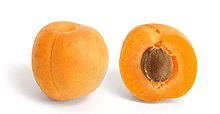
Most of the stone fruits are members of the Prunus genus of small trees and shrubs that are distributed throughout the temperate and tropical regions of the world, but few are as delicious as the apricot with its succulent, delicately sweet flesh wrapped in smooth, blushing red/orange skin. The ‘stone’ kernel (the seed) within is small and always simple to remove, meaning a good quality apricot is best eaten raw: just cut it in half, take out the stone and pop it in your mouth.
In the UK there used to be apricot orchards in sheltered southern areas with fertile soil, including the coastal zones of Glamorgan and Gwent in Wales, but now there is no apricot cultivation to speak of except in specialist nursery’s and private gardens. This is not because the sweet apricot variety in greatest demand doesn’t grow here, but simply because it is quite a high-maintenance, demanding plant that requires patience, expertise, care and attention – all qualities that don’t fit the money-grubbing motivations of the UK’s agriculture model. This means the apricots in supermarkets originate on vast plantations run by industrial producers in hotter climates where apricots grow easily like Türkiye, Uzbekistan, Iran, Algeria and Italy. If you must buy them, wash them well before use to eliminate chemicals, insecticides and faecal matter. For culinary use in a range of puddings and sweets, dried apricots are fine and are good value – but buy them at health-food shops and farmers’ markets and steer clear of the luridly-coloured versions from California that have been treated with Sulphur dioxide.
As is the case with most of the fruiting plants in the Prunus genus (plums, damsons, greengages, peaches, nectarines, cherries, almonds), in the UK they are no longer systematically grown for their fruit but instead have been cross-bred to act as small oriental trees renowned for their spectacular displays of pink blossom in front gardens and along suburban avenues in early spring. Transient, kitsch and petit-bourgeois, they seem to me to be pointless, twee image-enhancers rather than flourishing plants.
I bet that 90% of the UK population have never clapped eyes on, much less eaten, for instance, greengages, in Welsh eirinen werdd (Prunus domestica), surely the most delicious of all the Prunus stone fruits. That’s only because the supermarkets haven’t stocked them for years (not profitable enough). Apricots though have suffered an equally malevolent opposite treatment and become tarnished and belittled by extreme over-production that has eradicated their specialness.
I buy apricots in season from Beanfreaks in the Royal Arcade or Riverside Farmers’ Market or Carters Rhiwbina (delivery), and when they are no longer available I placidly accept the fact that there won’t be any more for another ten months. When I’ve got the time I have been known to make them into a pudding – and there are none better than this Italian classic:
TORTA DI ALBICOCCHE – TARTEN BRICYLL – APRICOT TART
INGREDIENTS
FOR THE PASTRY
140g (5oz) flour
70g (2½oz) butter
70g (2½oz) caster sugar containing the seeds of 1 vanilla pod
2 egg yolks, beaten
grated peel of 1 lemon
a few splashes of water
FOR THE FILLING
900g (2lb) apricots
a pinch of sugar and a splash of water
METHOD
1) Cut the apricots in half, remove the stones and soften them in a saucepan over a low heat for a few minutes with a little sugar and a splash of water, put to one side to cool
2) Gently combine all the pastry ingredients in a bowl
3) Knead lightly, roll out quickly and press into a shallow, greased 8inch pie tin
4) Arrange the apricots, drained of any excessive juice, on top of the pastry
5) Cook for 15 minutes in a hot oven, turn the heat down to low and cook for a further 10 minutes
6) Serve cold with whipped cream
Picture: Creative Commons