Hospitals
Various locations
Before the Anglo-Norman invasion and conquest, begun in the 12th century and finally accomplished in the 16th century, Wales was a pioneer in the understanding of natural healthiness, the arts of healing, the medicinal properties of plants and physicians’ codes and techniques, and was centuries ahead of its time in the treatment of illness and disease. But all that ancient knowledge and wisdom was wiped out and replaced by the English medical model based on jealously-guarded ‘expertise’, financial barriers, fraudulent ‘cures’, judgemental religiosity, sadistic experimentation and plain cruelty. The concept of the ‘hospital’ (like ‘hotel’, hostel’ and ‘hospitality’, derived from the Latin word for a lodging for travellers) arrived in Wales by the 14th century.
In Cardiff the first hospital was the Leper Hospital of St Mary Magdalene, built in the early 14th century outside the town walls on the main track eastwards (present-day Queen Street) and part of a small complex, including a chapel, a manor house and farm buildings, set in 15 acres of countryside. Maintained by gifts and the rents of the few tenant farmers, it provided beds for ’24 leprous, poor and feeble persons’ but could not generate enough income to sustain even that modest provision. The hospital was in a state of decay by the end of the 14th century and, despite the best efforts of the chaplain to continue helping Cardiff’s medieval poor for a while, it didn’t survive. By the time of the Protestant Reformation in 1534, when the manor and its land, still known as the ‘Spital’, was confiscated and sold off, it was a long-abandoned ruin. A thatched cottage was built on the site and for another 200 years the pastures were grazed by sheep and foraged by poultry as the Spital passed from owner to owner, eventually ending up in the hands of the Lords of Cardiff Castle and thence the Butes. As Cardiff expanded in the 19th century, most remnants of the Spital were eradicated – the last, the Spital barn on the north side of Queen Street, hung on until the 1890s while the cottage on the opposite side of the road was replaced in 1884 by a row of shops named Spital Buildings. This in turn was replaced by the Capitol Cinema in 1921 and then, after it was demolished in 1983, by the atrocious Capitol Centre shopping precinct in 1990. Many futile revamps later, the eyesore is fittingly repeating the fate of the lepers and dying a slow death.
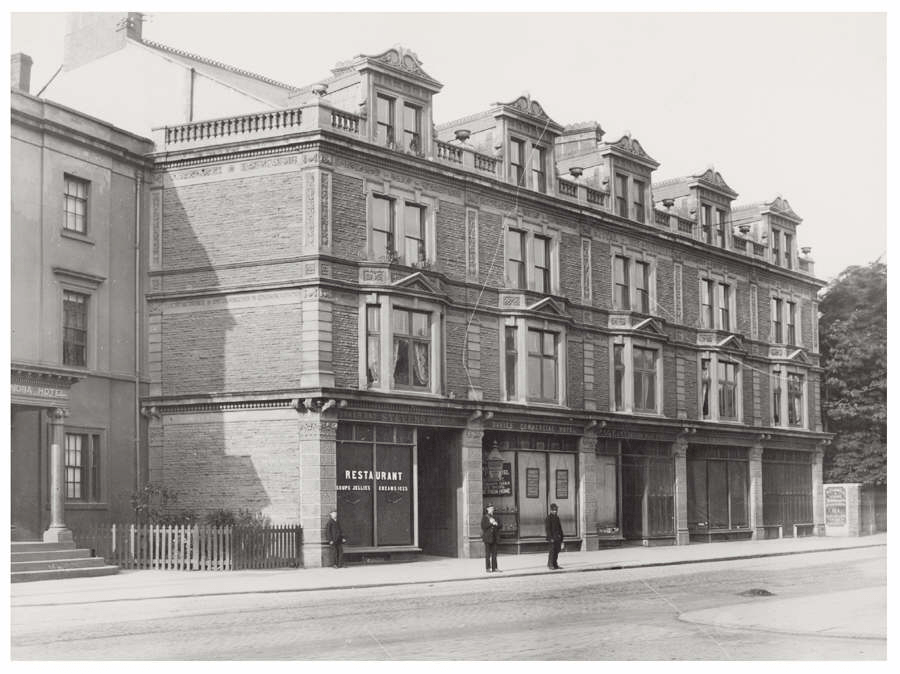
Until the industrial revolution Cardiff was a small village with no medical facilities at all, particularly after the dissolution of the monasteries eradicated the charity of the Blackfriars and Greyfriars religious houses. The few who could afford it paid for the services of self-appointed apothecaries while ordinary people relied on folk remedies or luck. It is important and revealing to remember that although life expectancy was much shorter than today in the middle ages, life span was hardly any less. If you lived to 21, you had as much chance of reaching 80 as people do now: it was the dangers of childbirth and high infant mortality in childhood that kept average life expectancy down to age 40 in the 17th century (compared to 78 now) not the lack of a pharmaceutical industry. All those much-trumpeted medical advances that provide a panacea for every and any human complaint imaginable have actually made next to no difference – except to satisfy the rapacious profiteering of Big Pharma. Only the disciplines of obstetrics and paediatrics along with a greater awareness of basic hygiene can claim to have genuinely improved the human condition.
The earliest approximation of a modern hospital came to Cardiff in 1823 when the Glamorganshire & Monmouthshire Dispensary was opened in a private house on Working Street near the vicarage of St John’s Church (demolished in 1879, along with the vicarage, to make way for the 1882 Free Library). Its apothecary, a Mr Roberts, resided at the dispensary and could see outpatients only, but its popularity quickly illustrated the need for a proper hospital. This was soon built, thanks to the generous financial support of Daniel Jones (1753-1841), who was related to the Bassets of the fabulous Old Beaupre Castle near Cowbridge. The Glamorganshire & Monmouthshire Infirmary duly opened in 1837 quite near the Spital Barn on the north side of Newport Road (then called Roath Road).

From the outset the clunky mock-classical concoction (architect unknown) could only cater for 33 patients and, though the number of beds was regularly increased, soon there was room for no more. A much bigger building was required, made more pressing by the 1858 arrival of the Rhymney Railway rattling windows on a high embankment close to the Infirmary’s western flank. When the new Infirmary (see below) opened in 1883 the old one was closed and taken over by the just established University College, remaining the University’s main building until the brand new HQ opened in Cathays Park in 1909. Enhanced by a dramatic Gothic tower centrepiece in 1915, the residual parts of the original building were demolished in 1960 and replaced by a discordant architectural hotch-potch extending in all directions and around the corner into West Grove. Now called Queen’s Buildings, one of the 120+ properties the University possesses in the city centre, the site is home to the Schools of Engineering, Computer Science and Physics & Astronomy.
Before the new Infirmary arrived, there were efforts to provide some sort of health care in the rapidly developing docklands. The Bute Docks Provident Dispensary at 170 Bute Street (then Bute Road) was established in 1858. Paid for by subscriptions, a doctor and a surgeon were available from 11am to 1pm daily and the Dispensary was a vital amenity in Tiger Bay through to the 1890s (later the building became a boarding house until demolition in 1959). Then the specific needs of the huge and ever-changing population of seamen began to be addressed in 1866 when the HMS Hamadryad, an obsolete 46-gun frigate, was converted into a hospital ship. Moored at ‘Rat Island’ in the tidal muds near the Sea Lock of the Glamorganshire Canal, it was run by Cardiff’s Medical Officer Henry Paine (1817-1894) and supported by the contributions of vessels entering the port. In 1905 it was superseded by a purpose built hospital (see below) and broken up.

Then came Cardiff Royal Infirmary in 1883 (originally named the South Wales & Monmouthshire Infirmary and later the King Edward VII Hospital before settling on CRI in 1923) and health provision in Cardiff was transformed. I have written in some detail about it here, so I will not repeat myself except to underline the fact that if devolution hadn’t happened, as so many rightwing Cymruphobes crave, Welsh health services would still be entirely run by the principled geniuses of Westminster, the beloved CRI would count as another lost building, and the site would now be covered in ugly blocks of ‘luxury’ buy-to-let flats.
Hospitals now came thick and fast, catching up with the booming coal port’s exponential population increase and covering all the fields of medicine. Although not including a hospital until 1923, when part of it was renamed St David’s Hospital, the Workhouse of Cardiff Poor Law Union on Cowbridge Road East in Canton had always included beds for the sick. Required to cover no less than 44 parishes across Glamorgan, the original Workhouse of 1839 soon proved inadequate so it was rebuilt and enlarged by Edwin Seward and his partners in 1881 in what was clearly a dry run for the CRI he was planning, down to the pyramid-roofed central tower. British Workhouses were where numberless hosts of the unemployed, destitute, impoverished, sick, old or just unlucky were fed and sheltered in deliberately awful conditions in exchange for grindingly hard unpaid work and humiliating obedience to strict rules of behaviour – or else be thrown out to starve or die in a ditch. Effectively they were cruel prisons for the crime of being poor. This terrible place, only marginally mitigated by the addition of a Hospital on the premises and a rebranding as the City Lodge ‘public assistance institution’, remained an outrage until the coming of the welfare state after WW2 abolished the Poor Law. St David’s Hospital then joined the NHS in 1948 and was remodelled to include a full range of NHS services until the drive to centralise all specialisms at one mega-hospital at the Heath systematically stripped it of its functions and it closed in 1991. The building stood empty and crumbling until most of it was demolished and a new much smaller St David’s Hospital opened to the rear in 2005, specialising in geriatric and orthopaedic medicine, while the striking tower and frontage was retained and converted into ‘luxury’ apartments for the gullible – paid for by the ‘Private Finance Initiative’ that has saddled Cardiff & Vale Health Board with debts for decades.

Very much associated with St David’s Hospital was Ely Hospital, two miles away on Cowbridge Road West. Established as a Poor Law ‘Industrial Training School’ for orphaned children in 1862, the dour mock-Tudor block (architect unknown) with five ominous ‘cottage homes’ for unwanted children in the grounds was made into a Workhouse for the mentally ill, the chronically infirm and the senile in 1903, acting as an overspill for the Canton Workhouse. When it became part of the NHS in 1948 it was designated a Mental Hospital and here one of the UK’s most shocking healthcare scandals took place. For decades vulnerable adults and children suffered unending torture and misery in this hell-hole until the NHS’s first ever brave whistle-blower exposed the horror and the News of the World made it public in 1967. It turned out that Ely Hospital had been a job creation scheme for every sadistic, abusive bully in Cardiff. The resulting enquiry in 1969 brought shame and notoriety to the city and the Hospital never recovered, closing for good in 1996. None of the culprits were prosecuted, sacked or named and the scandal gave the Tory government the perfect excuse to close down mental hospitals all over the UK to save money and replace them with the disastrous policy of ‘care in the community’ (translation: ‘neglect in the community’). The Ely site was sold, the buildings were demolished and it is now occupied by two supermarkets and their car-parks.

Lansdowne Hospital was opened in 1895 in a semi-rural location south of the mainline railway at Leckwith on Cardiff’s western outskirts. It was Cardiff’s first municipal hospital, funded entirely by the town’s ratepayers and designed by the Borough surveyor and engineer William Harpur (1853-1917) who was also responsible for, among other things, the Central Market, the layout of both Roath Park and the Civic Centre and the incredible Clarence Swing Bridge (demolished 1975). The Hospital was built as an ‘isolation hospital for infectious diseases’, intended for illnesses such as scarlet fever and diphtheria, and originally consisted of eight plain blocks in unappealing yellow brick. As time passed it expanded and was gradually surrounded by the inexorable march of housing to the east and industry centred at Ely Bridge to the west, evolving into a sanitorium and then a geriatric hospital after WW2. Into the 21st century it was reduced to community health services and health board offices while its continued existence was repeatedly threatened as care of the elderly was privatised and Cardiff Council increasingly looked to monetise every square inch of the city and go for growth at all costs. Then that traditional Cardiff phenomenon, the mysterious fire, more or less destroyed everything in 2019 and, lo and behold, problem solved. Cardiff & Vale Health Board sold it to Hafod housing association and a huge housing estate was spread across the entire site.

The Royal Hamadryad Hospital for seamen opened in 1905 on Ferry Road in Butetown, evolved into a psychiatric hospital when maritime Cardiff disappeared and closed in 2002. The dazzling red-brick and terracotta blockbuster overlooking the mouth of the Taff, designed by the Bute Estate’s inhouse architect Edwin Corbett (1849-1934), has been severely mutilated. The site is overwhelmed by overbearing ‘affordable’ (translation: ‘unaffordable’) flats plus a much needed Welsh medium primary school that likewise makes no concessions to aesthetics, leaving a mental-health day centre in what’s left of the hospital – so it definitely counts as a lost building.


Next in 1908 came the imposing Whitchurch Hospital – named originally, with almost refreshing bluntness, the Cardiff Lunatic Asylum. Designed by George Oatley (1863-1950) and Willie Skinner (1853-1937) of Bristol, the massive structure laid out on a herringbone plan with baroque styling, sustained bands of coloured brick and a spectacular Byzantine tower was set in beautiful spacious parkland off Penlline Road in what was then rural countryside. Cardiff’s alternative to the overcrowded Glamorgan Asylum in Bridgend (today’s Glanrhyd Hospital) had the capacity to house 700 patients and in the maze of echoing wards and corridors the new theories of psychiatry came to Wales. Quite quickly the Hospital, under the enlightened leadership of Edwin Goodall (1863-1944) was at the forefront of mental health care, treatment, research and understanding. Over the decades the Hospital changed many lives for the better – although that didn’t stop ‘You’ll end up in Whitchurch’ becoming a routine jokey admonishment across Cardiff. As the ‘care in the community’ trend took hold from the 1980s onwards, patient numbers in Whitchurch declined steadily, and after the Cardiff & Vale University Health Board decided to centralise all mental health services at Llandochau (Llandough) Hospital (opened 1933) near Penarth, Whitchurch Hospital was closed in 2016. It’s another Category Error by the centralising, cost-cutting ideologues in control, probably motivated by the desire to flog the Hospital’s prime land to volume house builders, destroy the environment, desecrate the Grade II Listed building and Grade II Listed grounds – and thereby make a killing in order to boost the fat salaries of platoons of parasitic ‘managers’. The building is still standing – but Cardiffians will have a fight on their hands to save it.
In 1913 Glan Ely Hospital opened in Fairwater (incorporated into Cardiff in 1922) specifically to treat tuberculosis (TB), a contagious and deadly disease that was brought under control later in the 20th century through improved sanitation and the bacillus vaccination. The sturdy building in what was then open countryside off St Fagans Road was demolished after the Hospital closed in 1991 and replaced by housing. Perhaps this was a little premature: TB is once more on the rise around the world, increasingly immune to antibiotics and the most lethal of all the infectious diseases.

The industrial-level carnage of WW1 put unprecedented demands on hospitals throughout the UK, causing normal services to be replaced by emergency measures. In Cardiff five Board Schools were commandeered as temporary military hospitals (Albany Road, Lansdowne Road and Ninian Park, which survive to this day, and Howard Gardens and Splott Road which no longer exist). They were run as sub-branches of the CRI, which acted as Cardiff’s main military hospital and was retitled the 3rd Western General Hospital for the duration. In addition, the University Settlement and St Fagans Castle were requisitioned as auxiliary hospitals.
After the War ended in 1918 new facilities were needed for the many seriously injured and permanently disabled. The Prince of Wales Hospital for Limbless Sailors and Soldiers opened in 1918 in a fine domestic house at 21, The Walk (then in Tredegarville, now Roath) that had formerly been a home of philanthropic department store owner James Howell (1835-1909) from Llanychaer near Fishguard. To mark the opening a cromlech was erected in the front garden by the distinguished surgeon from Llandysul in Ceredigion John Lynn-Thomas (1861-1939), a copy in Radyr Stone of the prehistoric cromlech at St Lythans. Under the inspiring leadership of Lynn-Thomas, the Hospital expanded into more properties to the rear at Richmond Crescent, gradually extended the undertaking to include civilian limbless people and became highly regarded for its considerable expertise in prosthetics. The Hospital remained at The Walk through WW2, before relocating to Rhydlafar (see below) in 1953. The building, converted into flats and now called James Howell House, has survived (as has the cromlech), but the extensive gardens, specially modified to include hills, valleys and varied gradients to help people get used to artificial limbs, are gone – infilled with more blocks of flats.

Another unplanned outcome of WW1 was Rookwood Hospital on Fairwater Road in Llandaf, a Gothic gem built in 1866 for Tory shipowner Edward Hill (1834-1902), son of the founder of Hill’s Dry Docks at the Bute East Dock. The mansion was further enhanced by Cardiff’s leading architect John Prichard (1817-1886) in 1881 to become a showy High Victorian masterpiece. Then in 1918 Rookwood was taken over for use as a convalescent home for officers before it was purchased by Laurence Philips, Baron Milford (1874-1962) and donated to the Ministry of Pensions to become a hospital for former members of the armed services suffering from paralysis (a role it repeated in WW2). In 1932 it became a general hospital and over time developed specialisms in spinal injuries, brain injuries, strokes, Parkinson’s disease, multiple sclerosis and rehabilitation services. All was swept away when everything was shifted to a new spinal and neurological unit at ever-expanding Llandochau and Rookwood Hospital closed in 2020. While the Health Board tries to sell it off to developers and somehow get around the building’s Grade II Listed status and the protected status of the marvellous 26 acres of gardens and grounds, Rookwood has been reduced to the artificial limb and wheelchair service and a vaccination centre.

The Prince of Wales Orthopaedic Hospital at Rhydlafar, off Llantrisant Road in north-west Cardiff, was the replacement for the Prince of Wales Hospital outlined above. It opened in 1953 on the site of what had been a US military hospital in WW2, taking over the Yanks’ rows of Nissen huts, and became a centre of excellence in the treatment of orthopaedic patients as well as the HQ of the Welsh Blood Transfusion Service. The Health Board then as now was always looking to centralise, especially when Heath’s gigantic University Hospital of Wales opened in 1971 and grew and grew remorselessly into Wales’ biggest building, a ravenous black hole swallowing every health service in its orbit. Rhydlafar was, inevitably, closed down in 1998 and a ghastly private estate of completely inappropriate speculative little boxes was promptly plonked on the rural site – a precursor of what was to happen all across north-west Cardiff’s green belt.

Further closures of Cardiff’s hospital stock have lately occurred at annexes of the CRI: the West Wing on Glossop Road, a 1949 Art Deco corker by Percy Thomas (1883-1969) complete with bold zig-zag exterior fire escapes, demolished for the sake of a half empty generic block of student flats in 2017 – expect an application for ‘change of use’ to serviced accommodation soon; and the delightful glass-tiled Longcross Street Clinic of the 1950s was pulled down in 2022 so that Cardiff can be blessed with yet another block of flats that nobody wants except property speculators.
Before concluding with a final entry, brief mentions must be made of nursing homes, convalescent homes and maternity homes that were never categorised as hospitals.
●Dulwich House, Dulwich Gardens: A convalescent home in Canton founded around 1870 for sick mothers and their children was closed in the 1980s and converted into flats.
●Nazareth House, Colum Road: A Catholic institution built in 1872 on land donated by the 3rd Marquis of Bute (1847-1900), originally established to provide for the aged, the poor and vagrant children. It still exists, now as a residential care home for the elderly.
●Northlands, North Road: Built in 1857 for coalowner Thomas Heath (1826-1887), the Gothic edifice became a maternity home in 1922, was ultimately demolished in 2013 and then rebuilt as a Salvation Army hostel for homeless young people.
●St Winefrides Nursing Home, Romilly Crescent: After 60 years this nursing home run by nuns was snapped up by property developers for lucrative housing, in the process destroying a peaceful enclave and a distinguished group of Art Deco and Victorian buildings.
●William Nicholls Convalescent Home, Newport Road: Donated to the CRI in 1926 by William Nicholls (1858-1932), manager of Spillers in Cardiff, the 1889 mansion called Tŷ-to-Maen in rural St Mellons was gradually engulfed by housing and then sold off when the UK government closed the CRI in the 1990s to become the fee-paying Catholic school St John’s College.
Lastly, I come to the Velindre Cancer Centre in Whitchurch, run by the disgraceful Velindre NHS Trust – one of only three NHS Trusts in Wales and the only one involved in actual treatment (the other two are the ambulance service and the public health service). Velindre is surely ripe for abolition. The charge sheet is long and damning, but boils down to the fact that, as they know all too well in England where there are 223 Trusts bleeding the NHS dry, NHS Trusts are run as private businesses geared to profit with their health responsibilities a secondary afterthought. They were established by the UK Tory government in 1990 as a way to introduce their beloved ‘market forces’ into the NHS – and the evidence of the last 35 years shows just how catastrophic Trusts have been as the English NHS has collapsed into a tragic, dysfunctional mess. Velindre is a classic example of how the profit motive should have no place at all in the NHS. The bosses of the Trust are fixated on property deals, destroying the richly biodiverse magical Northern Meadows nearby in order to build a totally unnecessary £885 million new cancer centre so that they can sell the perfectly adequate existing centre, built in 1956 and thoroughly modernised since, to volume house builders. If needed it could easily be upgraded at very little cost, or, should new build be essential, it could occur at one of Cardiff’s countless brownfield sites – but that would make economic sense and limit the Trust’s lust for empire building and fatter salaries so it’s out of the question. Meanwhile it has been revealed that two of the firms (from Japan and Spain) who have been awarded the contracts to develop the new cancer centre have been fined by regulators in those countries for rigging bids for construction contracts. And these are the outfits currently ripping up Cardiff’s wondrous Northern Meadows, a designated site of importance for nature conversation where over 1,000 trees are marked for felling, in complete breach of Wales’ Wellbeing of Future Generations laws.
But even worse, if that is possible, is the brazen hypocrisy trotted out by the Trust whenever they are criticised: we are supposed to swallow the laughable notion that they are just benevolent good guys trying to ‘defeat’ cancer. Nobody should fall for this lie. Cardiff has some of the highest cancer rates in the world, caused directly by exactly this type of contempt for nature. The contempt that has turned Cardiff into Europe’s worst cancer hot-spot where nuclear mud from England is dumped on the shoreline; where pollution and traffic mean the air is saturated with carcinogenic particles; where radioactive isotopes have been discharged for decades in staggering quantities into the air, the sewers and the rivers; the only UK city with an actual nuclear dump within its boundaries; the only UK city where the most lethal nuclear material known to humanity has been allowed to seep into the soil, into underground aquifers, and into the very veins, arteries, bones and nervous systems of Cardiffians. On these matters, the actual reasons why Velindre Cancer Centre is always packed with people, the Trust is strangely silent – well, there’s no money in preventative medicine – as they destroy the meadows, woods and natural world that might save us.
Pictures: Cardiff Central Library; Public Domain; Public Domain; Creative Commons; Creative Archive; Cardiff Central Library; Fred Jones; Alan Hughes/Creative Commons; Cardiff City Forum; Roath Local History Society; Public Domain; Don Llewellyn
A much more recent hospital building now vanished was the Iorwerth Jones centre on the Crystals. It was built some time in the 1980s as an old peoples’ home I think, and taken over by the NHS about 20 years ago, as a mental health hospital. It was demolished a few years ago, and “affordable” housing built on the site.
Shortly before it closed, I remember meeting an old geezer on the footbridge over the Llanishen brook, just around the corner from the centre. He seemed a bit agitated and we got talking about this and that and it turned out he walked over every day from his home in Whitchurch to visit his wife who was a resident in the centre. He’d just found out that it was closing and all the patients were being moved to Llandough. He didn’t know what he was going to do. Not a lot you can say, really.