Cardiff Arms Park
Westgate Street
The story of Cardiff’s ‘fields of praise’ is as good an example as any of the parlous state of the capital of Wales in the 21st century:
1766: The Herbert dynasty, Glamorgan’s ruthless primary landowners for over 200 years, gradually relinquished their grip on Cardiff through the 18th century as they ran out of male heirs, concentrated on their more lucrative English holdings or just lost interest in the insignificant little port. Through a complicated series of strategic marriages, most of Cardiff was eventually acquired in 1766 by Scottish Tory aristocrat John Stuart (1744-1814) – made the 1st Marquis of Bute in 1794 – when he married Charlotte Windsor (1746-1800).
1803: The Marquis didn’t like staying in the uncomfortable Castle on the rare occasions he came to Cardiff, so he bought the Cardiff Arms Hotel opposite along with its rear gardens leading down to the River Taff. The imposing building, the first that travellers to Cardiff saw when approaching from the west, had been built by the Bradley family in 1792 on the site of the ancient Tŷ Coch inn, destroyed by fire in 1770.
1850: The South Wales Railway from Chepstow to Swansea opened a station in Cardiff on land gained after the meandering Taff had been shifted westward into a straightened new ‘cut’. A side-effect of this was to greatly increase the area of Bute land behind the Cardiff Arms Hotel. Originally named Great Park, much of it was mud and stagnant pools where the old river bed had been and it quickly became used as a rubbish dump.
1865: The Council and the Railway Company finally filled in Cardiff’s “open sore,” allowing Westgate Street to be laid out and the terraces of Temperance Town to be built to the south. The remaining 18 acres of damp meadowlands were set aside for recreation and civic events by the 3rd Marquis (1847-1900) and renamed Little Park.
1867: Cardiff Cricket Club established a permanent home in the north of the park and constructed a small wooden pavilion.
1875: Access to the park was restricted to bona fide sports organisations following vandalism and “acts of mischief.”
1876: Cardiff RFC was founded when two clubs, Glamorgan and Cardiff Wanderers, amalgamated following a meeting at the Swiss Hall to the rear of Swiss Chambers in Queen Street (all demolished in 1915 and replaced in 1919 by a monumental branch of the Midland Bank – now HSBC). The new club moved into the southern part of the park.
1878: The Cardiff Arms Hotel was demolished to allow for road widening of what is now Castle Street – today the Angel Hotel occupies most of the site. The park soon began to be called Cardiff Arms Park in memory of the old landmark.
1884: Cardiff Arms Park hosted its first international fixture. Wales beat Ireland by a drop-goal and two tries to nil in front of 5,000, gathered behind ropes around the pitch. The players changed in the Angel.
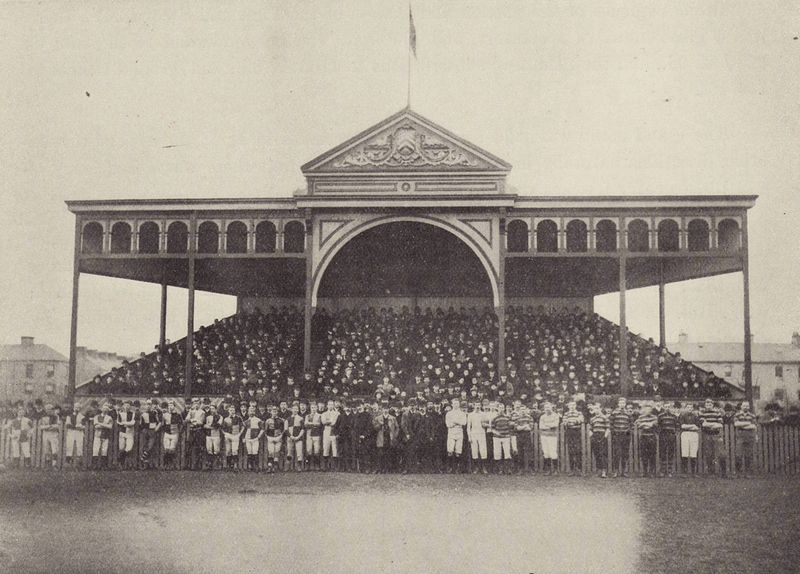
1885: The first proper grandstand, seating 500, was erected on the south side backing onto Park Street. It is incorrectly stated on Wikipedia and elsewhere that this stand was designed by Archibald Leitch (1865-1939), who went on to design 42 soccer grounds in England and Scotland, but that cannot be true since he was barely 20 at the time, did not qualify as an engineer until 1890 and it is well established that his first stadium works were in his home city of Glasgow at Ibrox Park, Parkhead and Hampden Park at the start of the 20th Century. There has been a mix-up with Leitch’s corroborated work at the Arms Park which came much later (see below) and therefore the architect of this inaugural stand has to be declared anonymous. In any case, within a decade the first South Stand had been pulled down and replaced by a stand holding 7,000 spectators.
1888: Cardiff Lawn Tennis Club took up residence to the north west of the cricket ground.
1889: Glamorgan Cricket Club obtained a tenancy of the cricket ground.
1896: The Welsh football team made a disastrous first appearance in Cardiff, losing 1-9 to England at the Arms Park. The result remains Wales’ worst-ever home defeat, worst-ever defeat by England and 2nd worst defeat of all time.
1899: The rugby ground now had a capacity of 36,800 after wings were added to the South Stand and banks of terracing were raised on the other three sides.
1900: The WRU got involved for the first time, entering into an agreement with Cardiff RFC to fund stadium improvements.
1904: Glamorgan built a lavish new two-storey pavilion in the south-west corner of the cricket ground, which included modern changing rooms for both cricket and rugby.


1905: Wales defeated New Zealand to clinch the Welsh passion for rugby. In response to the haka, the estimated 40,000 crowd broke into Hen Wlad fy Nhadau – the first time a national anthem was sung at a sporting event.
1910: Wales lost 0-1 to England in the 4th and last soccer international played at the old Arms Park.
1912: The familiar oval shape was now in place as capacity rose to 43,000 with a new double-decker South Stand and enlarged terraces.
1922: Cardiff CC and Cardiff RFC formed Cardiff Athletic Club to purchase the Arms Park (except for the tennis courts adjoining the top of Westgate Street) from the 4th Marquis of Bute (1881-1947) for £30,000. Under the terms of the sale the land was to be preserved for recreational purposes in perpetuity. A complex limited company was set up, involving a spin-off greyhound racing company and the WRU, and ensuring Machiavellian wranglings for decades to come.
1923: The Tennis Club moved to the Castle Grounds (but the Bute-owned courts remained for a while) and Glamorgan CCC installed seating on the north-east of the cricket ground.
1928: Regular greyhound racing began on a track laid around the rugby pitch, and partial cover was provided over the North Terrace.

1934: A new double-decker stand – which was designed by Archibald Leitch – was erected on the north side of the rugby ground, entailing the demolition of the cricket pavilion. The North Stand would become a Cardiff symbol, seeming to tower over the town. From its precipitous upper reaches the spine-tingling communal singing for which the Arms Park became renowned would invariably start. The Bute family were pissed off: the stand ruined the view from their Castle apartments. In retaliation they built blocks of flats along the east side of Westgate Street to block their view of the North Stand, so eliminating the tennis courts and shrinking the boundaries of the cricket ground. Meanwhile the back of the South Stand was being established as Cardiff’s all-purpose meeting place and unofficial notice board.

1941: During a heavy bombing raid a landmine severely damaged the North Stand. Repairs would not be completed until 1949, meaning wartime internationals had to be played elsewhere.
1948: Glamorgan commenced improvements to the cricket ground, lifting capacity to 15,000 with seating at the Castle End and along the west side.
1954: The last international match was played at St Helen’s, Swansea, where Wales’ very first international at home had taken place in 1882. From now on only the Arms Park would be used by the WRU and Cardiff hosted two internationals per season in the Five Nations instead of just the one when duties were shared with Swansea. (In the 19th century Rodney Parade, Newport, and Stradey Park, Llanelli, had also staged Wales matches). The Arms Park had arrived as Welsh rugby’s spiritual home.
1956: Overall capacity of the rugby ground increased to 60,000 with the addition of a new tier to the South Stand, jointly financed by Cardiff Athletic Club and the WRU.
1958: The Commonwealth (Empire) Games were held in Cardiff, the Arms Park being used for the athletics events and the opening and closing ceremonies. The compacted turf took a pounding from which it never really recovered. The rugby pitch increasingly came to resemble the muddy bog it had been a century before, prompting the WRU to plan major changes.

1968: At last the WRU obtained the freehold of the rugby stadium, while Cardiff Athletic Club kept control of the cricket ground. The horse trading entailed Glamorgan CCC and the cricket and hockey sections of the Athletic Club moving to Sophia Gardens (the bowling section kept their green at the northern end of the cricket ground while the greyhound track lasted until 1977). Work started on developing what would be called the National Stadium plus a 15,000 capacity stadium for Cardiff RFC on the cricket ground which would retain the Arms Park name.
1970: The National Stadium and the new club ground, slotted behind the new cantilever-roofed North Stand, officially opened. Designed by Osborne V Webb & Partners, it took another 14 years to complete the National Stadium to its planned 65,000 capacity (which would be reduced to 53,000 in 1997 for safety reasons).

1987: David Bowie (1947-2016) played at the Stadium, the first of many major music concerts to be staged as the WRU’s commercial department became ever more important.
1989: The WRU and the FAW stopped pretending the other didn’t exist as the first international football match for 79 years was played at the old Arms Park, Wales drawing 0-0 with West Germany.
1993: Boxing arrived, and a TV audience estimated at two billion, plus 25,000 in the ground, watched the world heavyweight title fight between Frank Bruno and Lennox Lewis.
1997: Demolition of the National Stadium began only 13 years after it was completed. The WRU had won the right to stage the rugby world cup and needed a bigger capacity and a more modern venue.
1999: The Millennium Stadium, a 74,500 capacity scarlet bear pit complete with a retractable roof, opened in time for the rugby world cup, the last major world sporting event of the 20th century. Construction required the realignment of the playing area which was turned on its axis to run north/south rather than east/west. Cardiff RFC’s adjacent ground to the north meant the stadium had to be completed with a break in its bowl structure, known as ‘Glanmor’s Gap’ after Glanmor Griffiths (1939-2023), the WRU chairman (and later President) who was the driving force behind the Stadium. New access points from Westgate Street, Wood Street and the Taff Embankment involved the demolition of many surrounding buildings including the Empire Pool. Inevitably the final cost of £126 million overshot the budget, despite a £46 million grant from the National Lottery’s Millennium Commission which lumbered the ground with its name. The building, with its four gigantic corner struts, aggressively dominated Cardiff in a way its predecessors never did and soon became the city’s public image.
2001: The WRU abandoned the concept of a national stadium exclusively for Wales and, desperate to reduce its debt, threw the place open to all-comers: the English FA use it for the FA Cup final and all their league play-offs and minor cup competitions for six years while Wembley was being rebuilt; the red carpet was rolled out for rugby league, motocross, speedway, rallying and monster trucks; from Tina Turner (1939-2023) to Robbie Williams, Tsunami Relief to the Jehovah’s Witnesses, Songs of Praise to Doctor Who – pay up and it was yours. Predictably this approach had diminishing returns: overkill cheapens the magic, newer, bigger stadia get in on the act, ‘wow’ turns to ‘so what?’
2003: The club game in Wales was devastated by the unnecessary creation of five unnatural ‘regions’ (quickly cut to four when Bridgend-based ‘Celtic Warriors’ disbanded after just one season). Ineptly modelled on the completely different Irish provinces and the Southern Hemisphere franchise system, the regions have been a spectacular failure. This was the first in a sequence of terrible WRU blunders, initially obscured by the national side’s tremendous form under coaches Mike Ruddock and then Warren Gatland between 2005 and 2019 when Wales won four Grand Slams in the Six Nations and reached two World Cup semi-finals. However, ultimately the blunders could not be ignored: the ridiculous eligibility rule that prevented players being capped if they played outside Wales; the perverse reluctance to embrace the Welsh language; the stubborn refusal to abandon the ‘three feathers’ badge that is a symbol of England’s control of Wales; the embarrassing grovelling to the English royals; the revelations of sexism, bigotry and bullying; the lawsuits alleging systemic failure to protect players’ health; the tone-deaf renaming of the Millennium Stadium as the insulting and provocative ‘Principality Stadium’ to raise revenue from the Principality Building Society; the grievous evaporation of the Arms Park’s legendary passion, mass communal singing and unique atmosphere, caused by the pricing out of ordinary Welsh people…and on and on – it takes incompetence of the highest order to get so much so very wrong. All these issues increasingly have come into focus by 2025 as the Welsh team endured its worst-ever sequence of results (18 consecutive defeats), went nearly two years without a win and sank to a lowest ever world ranking of 14th.
Today: Cardiff Blues have been a massive flop as a region, and being rebranded as ‘Cardiff Rugby’ in 2021 has made no difference. The appallingly mismanaged club collapsed financially and put itself into administration in 2025, owing nearly £3million to over 100 creditors, and the WRU were forced to fork out £780,000 to take over directly and keep the club going. As it stands, the WRU dare not let Cardiff Rugby die as they try to cut the regions down to three – but only conflict and uncertainty lie ahead, with no guarantee the problems can be resolved, especially with the WRU being led by corporate British (translation: English) clones Chief Executive Abi Tierney and Chair Richard Collier-Keywood. Speculative developers are gathering like vultures licking their lips at the prospect of getting their claws into the Arms Park slice of prime city centre real estate. Cardiff Athletic Club controls a chunk of it and it’s no secret there are those who would like to drive a double-decker bus through the Marquis of Bute’s fussy old codicils when the economic climate is right. But surely, whatever happens, most of ‘Taff’s Acre’ is safe? Surely the Millennium Stadium, Cardiff’s beating heart, can never be transplanted? Oh…but hang on a minute…this is Cardiff, a city for hire where nothing is sacrosanct and everything has a price-tag…
Pictures: Public Domain/Creative Commons; Cardiff Rugby Museum; Fred Jones; Britain from Above/RCAHMW; Amgueddfa Cymru; Rugby Relics; People’s Collection Wales
Wonderful, as ever. Diolch x