Here, in chronological order, is a selection of some of the bigger fires that have happened over the years in Cardiff. Excluded are fires in domestic buildings, fires caused by wars – specifically the Welsh Wars of Independence (c400-c1500), the English Civil War that spilled over into Wales (1648) and World War Two (1939-1945) – and the mostly unrecorded fires in the centuries when Cardiff was a small town consisting almost entirely of wooden buildings.
🔥1877: THEATRE ROYAL
Theatres have traditionally been susceptible to going up in flames, what with all those costumes, props, wooden boards, artificial lights and unpredictable audiences, not to mention temperamental luvvies throwing tantrums backstage. So it proved in Cardiff, beginning with the Theatre Royal. Erected in 1826 at Crockherbtown (now Queen Street), it was Cardiff’s first purpose-built theatre, paid for by subscriptions and donations. The mock-classical effort must have seemed an alien intrusion in what was then a rural scene of thatched cottages and market gardens. The Theatre was adjacent to the substantial home of William Bradley (1787-1841), a scion of the Bradley family that built their wealth in the mail and coaching business operating from the original Angel Hotel and went on to run the Cardiff Arms and become property developers in Roath. The Royal was regularly flooded by underground springs, a problem only resolved when the Dock Feeder opened to the Theatre’s east in 1839. But in 1877 it was completely wiped out by a fire that started in bundles of straw kept in the painting shed at the rear of the building. It was quickly replaced by a new Theatre Royal in Wood Street the following year (see below), while the Park Hotel (currently Leonardo Hotel after being bought by a Berlin-based chain) was built on the site in 1884.

🔥1882: SPILLERS MILL
The Spillers grain milling business was founded by Joel Spiller (1804-1853) in Bridgwater, Somerset, in 1829. The company rapidly expanded across England and into Wales, opening a steam-powered flour mill at the top of Cardiff’s West Dock in 1854. In 1882 extremely inflammable clouds of flour dust combined with machinery sparks to ignite a vicious fire that destroyed the mill and its adjacent marine biscuit factory. There were no casualties as the mill workers had time to escape. The building was soon replaced by a number of larger modern mills in the same area, particularly along Collingdon Road and at East Dock and Roath Dock. Over the years Spillers went through a series of amalgamations before its Cardiff operations eventually ceased in the 1980s after corporate takeovers. Lloyd George Avenue now covers the filled-in West Dock and the eradicated Collingdon Road while a single Spillers building has survived as a block of flats alongside the truncated old East Dock, today called Atlantic Wharf.

🔥1885 CARDIFF MARKET
The first purpose-built indoor market on St Mary Street was a rudimentary shed erected in 1836 on the site of Cardiff gaol, which had been moved to its current location in 1832. This was replaced in 1884 by a grandiose edifice funded by hyperactive entrepreneur Solomon Andrews (1835-1908).

Just a year later one of Cardiff’s most devastating fires annihilated Andrews’ building. The culprit was the wooden flooring, with the heat generated so intense that the fire station on the other side of St Mary Street was nearly set alight too.

Never one to be fazed by mere catastrophe, Andrews simply had an exact replica built within a year – but this time with concrete floors. However, it was almost as ephemeral: the Council took control of what was very much a public amenity and, applying stricter planning rules, replaced it with an even larger market building in 1891, designed by Borough Surveyor William Harpur (1853-1917). Surprisingly, in a city where anything more than 30 years old is seen as prehistoric, it survives to this day.
🔥1892: MERCHANTS’ EXCHANGE
The Merchant’s Exchange at the Pier Head opened in 1875 and was gutted by a mysterious fire in 1892. Purely coincidentally, this was a happy accident for the consortium of Docks’ businessmen behind the speculative venture: the massive insurance pay-out funded a complete and enlarged rebuild. For the full Merchants’ Exchange saga see Cardiff’s lost buildings 1.

🔥1893 WESTERN MAIL BUILDING
The Western Mail, founded in 1869, moved into purpose-built premises on St Mary Street in 1871. The building was destroyed in 1893 by a ferocious fire (probably caused by an electrical fault) that triggered leaping flames visible three miles away on Rumney Hill. For details of what happened next see Cardiff’s lost buildings 6 .

🔥1899: THE EMPIRE
Originally called Levino’s Music Hall when opened on Queen Street in 1887, before being completely rebuilt and renamed the Empire just two years later to the designs of celebrated music hall architect Frank Matcham (1854-1920), the baroque showpiece was destroyed in 1899 by a fierce conflagration that “lit up Cardiff from Queen Street to Colum Road”.
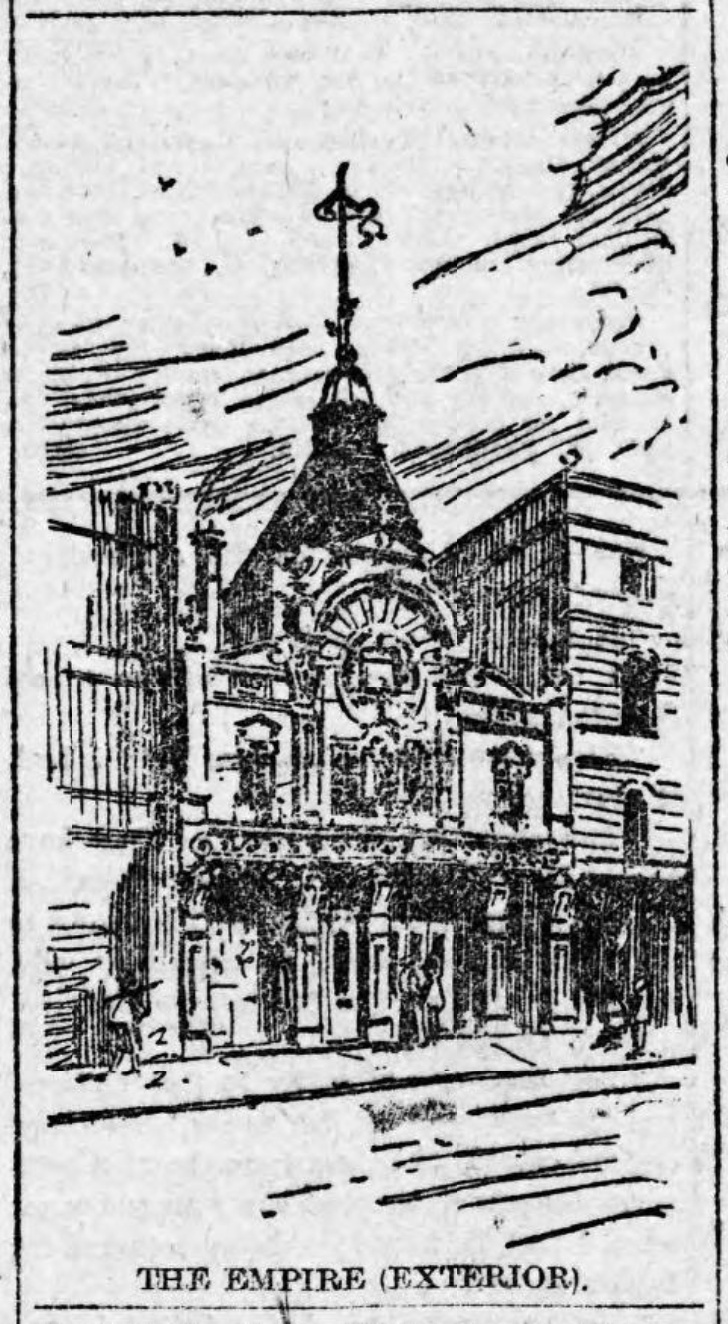
Within a year the theatre’s pushy owner Australian Oswald Stoll (1866-1942) had hired Matcham to rebuild an enlarged and improved Empire. It was eventually sold to Gaumont in 1930 and converted into a swish cinema which was closed in 1961 and demolished in 1962. A series of regularly revamped new buildings took over the site, occupied in turn by clothing chains C&A, Primark and currently Matalan.
🔥1899: NEW THEATRE ROYAL
In 1878, just a year after the original Theatre Royal’s demise (see above), a replacement was built on Wood Street to the designs of Walter Blessley (1839-1915) and Thomas Waring (1825-1891), two prolific Cardiff architects. Unfortunately, in 1899 it suffered the same fate as its predecessor when lax storage procedures resulted in a major fire that destroyed the building’s interior. But, with admirable resilience, the management made sure the Theatre was promptly rebuilt precisely as before – with the addition of improved fire precautions! A new frontage facing St Mary Street was added in 1920 and it was renamed The Playhouse. What happened subsequently, through to its current incarnation as Wetherspoon’s pub The Prince of Wales, can be read here.

🔥1907: EAGLE BREWERY
Located at 10 St John Square opposite St John’s Church and adjacent to the Tennis Court pub, the Eagle Brewery was established in 1846 by Mancunian William Nell (c1806-1871). At its thriving peak, Nell’s, as the family-owned Brewery became known, ran five freehold and seven leasehold pubs in Cardiff including the 1853 Vulcan in Adam Street, now preserved at the St Fagans National Museum of History. A serious fire in 1907 was the beginning of the end for Nell’s. Steep rebuilding costs followed by WW1 and economic recession forced the brewer to sell up to Ely-based Crosswells and the Eagle was quickly closed and demolished. The Tennis Court (later the Buccaneer and now the Owain Glyndŵr) expanded onto the site.

🔥1915: THE ELECTRIC THEATRE
Cardiff’s very first cinema was opened by London & Provincial Electric Theatres in 1909 on Queen Street. It had a 600-seat auditorium with a pit where its own orchestra accompanied the silent films. All was going well until, of all things, an electrical fire ripped through the cinema in 1915, making it the shortest-lived of all Cardiff’s cinemas. The proprietors decided not to rebuild and the ever adventurous Solomon Andrews bought the site and neighbouring buildings for the construction of huge Dominions House. Much altered, it’s still there today.

🔥1919: A.McLAY PRINTERS
In 1898 Scotsman Archibald McLay (1863-1922) acquired a small Duke Street printworks that could trace its origins to Swansea in 1801. The growing business moved to larger premises in Working Street in 1910 but nine years later an uncontrollable fire reduced the building to rubble. McLay bounced back from the disaster and in 1921, just before he died, he moved A.McLay & Co to a purpose-built factory on a greenfield site off Fairwater Road. Through takeovers, management buy-outs and mergers McLay’s flourished and in 1997 moved to Longwood Drive at Fforest Farm in north Cardiff. Today it is one of the UK’s leading commercial printers. The Working Street site has been swallowed up by the St David’s shopping centre and housing replaced the Fairwater factory.

🔥1926: COLONIAL BUILDINGS
New Street was laid out following the 1875 demolition of a triangle of streets on the south-east side of the Glamorganshire Canal directly opposite Mill Lane on the Canal’s north-west side. The motive for this wholesale destruction was quite simple: the eradication of what was then Cardiff’s notorious ‘red light’ district, the tightly packed terraced houses and pubs of Canal Bank, Coleman’s Row, Charlotte Street and the north side of Whitmore Lane (today’s Custom House Street). New Street became one of the eight tentacles that radiated from the bottom of St Mary Street where the Canal straightened out and turned due southward towards the sea and was soon lined with warehouses, factories, offices and various commercial premises. The imposing Colonial Buildings, built in the 1880s, had numerous occupants over the years – at the time of its demise fruit and vegetable merchants and the Percy Cadle company, a manufacturer of tobacco products and cigarettes. One of Cardiff’s largest ever fires turned it into a roofless shell in 1926 and severely damaged a number of adjacent properties on New Street and Custom House Street in the process. No cause of the inferno was ever established – a carelessly-discarded fag being, presumably, far too obvious. The fire signalled the beginning of New Street’s decline; the Colonial Buildings were not replaced, other buildings were patched up and neglected; the Canal was filled in; the outdoor fruit and veg market was moved here from The Hayes for a while and then, in the 1980s, New Street was erased from the map and taken over by (even more short-lived) superstores and an ice rink. Today the site is occupied by the Marriott Hotel, a car park, the Central Library and bus lanes. New Street lasted a century; it’s a fairly safe bet that none of those will.

🔥1935: CROSS BROTHERS IRONMONGERS
Starting out in 1856 as Cross & Herne at number 3 St Mary Street, in 1880 the ironmongers became Cross Brothers and expanded into number 4 next door, so occupying the whole four-storey Gothic corker with its splendid array of arched windows topped by Flemish dormer windows on the roof. A Cardiff institution, the retailer also specialised in furniture and china and had smaller outlets in Church Street and Working Street. But the one cast-iron certainty about Cardiff is that nothing lasts for very long and the decline of Cross Bros began in 1935 when a terrible inferno, probably started in a store room, destroyed the entire building. By the 1970s the company that had seemed impregnable was no more. A sleek modernist construction rose on the St Mary Street site. Initially a Co-op department store, many occupiers have come and gone and currently its tenants are the cocktails and darts chain Flight Club.

🔥1937 NINIAN PARK GRANDSTAND
Following a 1-3 FA Cup 3rd Round defeat to Grimsby Town on January 16th 1937, Cardiff City’s directors were somewhat consoled by the takings from the 36,245 crowd, the biggest of the season. In the early hours of Monday January 18th unknown thieves got into the grandstand (built 1910) and attempted to break open the safe with explosives in the mistaken belief that it held sacks of cash. The safe was in any case unyielding but the flimsy wooden structure went up like a tinderbox and the foiled robbers fled. At 3 o’clock in the morning a policeman on his beat noticed the flames and called the fire brigade, but it was too late. The stand, along with its dressing rooms, offices and the club’s records, was destroyed and, most upsettingly, the watchdog called Jack and a cat kept to catch rats were killed. The grandstand was rebuilt in brick and steel in 1938 and extended in 1973 before Cardiff City moved to a new stadium nearby and Ninian Park was demolished in 2009.
🔥1937 ELY RACECOURSE GRANDSTANDS
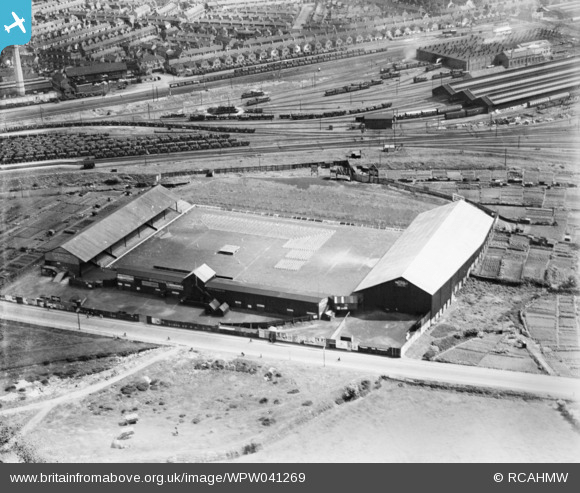
Following the 1849 closure of the Great Heath racecourse (covered by the suburb of Birchgrove in the 1920s), a consortium of Glamorgan farmers set up Ely racecourse just south of Cowbridge Road in 1855. The jumps track became Wales’ leading racecourse, staging the first running of the Welsh Grand National in 1895 and drawing big crowds to its programme of winter/spring steeplechase meetings. Spectator facilities were regularly improved over the years until seating for over 2,000 was provided in a phalanx of stands on the course’s north flank. Ely’s fortunes started to decline after WW1 for a number of reasons: economic depression, mass unemployment, bad behaviour, petty criminality and the censorious snobbery of Cardiff’s ‘respectable’ middle-classes. The final nail in Ely’s coffin came in late 1937 when the two main grandstands were suspiciously burnt to the ground, giving the authorities a convenient reason to close the course in 1939. Housing, schools and sports pitches subsequently took over the site.

🔥1946: MERTHYR HOUSE
Merthyr House was a monumental monolith in Bath stone erected in 1918 on the James Street/Evelyn Street corner close to the Glamorganshire Canal in Butetown. Designed by Henry Budgen (1866-1948), an architect responsible for many striking commercial buildings in Cardiff’s docklands, Merthyr House’s six storeys provided offices for prominent coal and shipping companies until it suffered devastating damage in a fire on a Sunday when there was nobody in the building. Arson was mooted as an explanation but no evidence was found. It was never rebuilt, Evelyn Street was erased by 1960s ‘slum clearance’ and the site remains empty wasteland to this day.

🔥1958: THE HAYES BUILDING
Also known as the Atlas Building, the Hayes Building was constructed in 1893. It was one of Solomon Andrews’ (see above) many initiatives in Cardiff, providing manufacturing, office and retail space for rent in a prime position opposite the David Morgan department store on The Hayes. The ostentatious four-storey extravaganza was designed by the Bute Estate’s in-house architect Edwin Corbett (1849-1934) and was home to countless businesses over the years until it was reduced to rubble by a destructive fire on an August night in 1958. Packed with inflammable items, the Hayes Building’s fire took a day for firefighters to bring under control and stands as Cardiff’s biggest ever fire outside of WW2. The ruinous remains were sold and in 1962 the Oxford House and Oxford Arcade development replaced it (as well as the fire-damaged Central Cinema and Oxford Hotel to the south). Just 44 years later all that was in turn flattened to make way for St Davids 2 (now 20 years old, so this shrine to pointless consumerism is already, in Cardiff terms, old hat and overdue for demolition).

🔥1989: BROADWAY WESLEYAN METHODIST CHAPEL
One of many chapels in Cardiff designed by architect William Habershon (1818-1891), the Wesleyan Methodists was located opposite the Cyril Crescent junction near the western end of Broadway in Roath (later Adamsdown). It opened in 1879 and closed in 1950 as Christianity in general and Nonconformism in particular ebbed across Wales. Periods as the BBC’s first TV studio in Wales, a carpet warehouse and finally a mosque followed, until it was wiped out in September 1989 by a spectacular night-time fire, boosted by the explosion of propane gas cylinders inside the mosque. The inferno spread to adjacent homes and small businesses which were also destroyed in the intense heat, and it was only by luck that nobody was killed. What started the fire was never identified, making it one more puzzling Cardiff conflagration. Within days demolition crews had done their work and a cheap’n’nasty block of flats was promptly built on the site.

🔥1996: REGENT CINEMA
Opened in 1928 to serve the huge new Ely estate, the Regent was a bulky brick structure with Art Deco touches on Mill Road. As TV shrank cinema audiences, bingo took over in 1968 but that fad petered out and the old cinema closed for good in 1996. Swiftly becoming dilapidated, it was a remarkable stroke of luck for the owners when it soon suffered severe fire damage and had to be demolished. The site was sold and is now occupied by the Regency House ‘luxury’ care home.

🔥2001: PANASONIC WAREHOUSE
In 1975, lured by Welsh Development Agency bribes incentives, Japanese electronics giant Panasonic established a factory at the brand new Pentwyn estate in north-east Cardiff and began manufacturing components for TVs and microwaves. In the beginning 2,400 were employed as low-paid and low-skilled assemblers, but the shifting currents of international capitalism and ever-evolving technology moved on and that number has been remorselessly reduced to 300 today – and, for all the company’s trumpeting of its recent ‘sustainability’ gestures, nothing can gloss over the fact that the vast, ugly factory was a key component in the wanton destruction of what had been beautiful countryside not so very long ago. It’s also dangerous, as shown in 2001 when the factory’s massive warehouse was totally extinguished by a frightening fire that took 70 firefighters five hours to bring under control. A painstaking investigation failed to pinpoint the cause. The bland generic boxes of Wyncliffe Gardens were built on the factory site in 2008 and since then developers Persimmon allowed the adjacent playground, built as a condition of the planning permission, to become a dangerous eyesore while the Council huff and puff and do nothing.

🔥2003: THE CENTRAL HOTEL
Built in 1877 on the West Wharf/Penarth Road/Saunders Road corner of the eight-pronged junction radiating around the axis of the Custom House Bridge and the Marquis of Bute statue, the Central Hotel was an instant success. For visitors arriving at the nearby mainline railway station it was a blue-collar alternative to the flashy 1875 Great Western Hotel on the other side of Saunders Road. Over the years it became something of a Cardiff institution with its bars, late-night lock-ins, music nights, creature comforts and easy-going ambience. But after being sold off to property developers in the 1960s, it was allowed to slide into grubby neglect and closed down in 1993. Being Grade II listed, the rotting building couldn’t be demolished – so it was rather handy for the land owners when a rampant fire ripped out its innards in 2003: oh, what an uncanny coincidence! With the embarrassing wreck the first thing rail passengers saw as their train arrived in Cardiff, the Council finally buckled and allowed demolition. More years then rolled by before the Irish hospitality chain Dalata took the plunge and imposed a small throwaway tower on the site. At first it was included in their ‘Maldron’ stable and recently, in an ominous sign that the hotel is struggling, it has been rebranded as one of their ‘Clayton’ offerings.


🔥2015: SPLOTT CINEMA
Opened in 1913 on the Agate Street/Pearl Street corner and considerably expanded in 1930 for the sound era, Splott Cinema was a giant white hulk with 2,000 seats. In 1960 it became one of Cardiff’s first bingo halls and it remained a popular social centre and intrinsic part of Splott life, regardless of ever-changing ownership, right through to 2009 when the smoking ban delivered a fatal blow. For years it was scandalously left empty, vandalised and rotting, until it miraculously self-combusted in winter 2015 despite being so saturated in damp that moss covered the walls and trees grew out of the roof. How strange! The fire could not have been more opportune for property developers and, lo and behold, as soon as the economic climate made it profitable enough a block of flats was duly plonked on the ground in 2023.

🔥2019: LANSDOWNE HOSPITAL
In 2019 that abiding Cardiff curiosity, the inexplicable autonomous fire, brought an ignominious end to the life of Lansdowne Hospital, which had been Cardiff’s first municipal hospital in 1895. For more, see Cardiff’s lost buildings 10.

🔥NOWADAYS
For a number of reasons, such as tighter safety and the massive decline in the smoking habit, the jumbo fires of the past are less frequent. Moreover, the need to set your own building on fire in order to fraudulently claim insurance or side-step planning restrictions is increasingly unnecessary in a city where the Council is all too ready to submissively comply, no questions asked, with whatever is demanded by Big Business. Nevertheless, every year the fire brigade is kept busy by random events. For instance, last year (2025) the showroom of Fiddes & Son, a specialist supplier of traditional wax for varnishing wood, based at Brindley Road in Leckwith, was engulfed by an overnight fire that started in a storeroom and destroyed the premises. And Dyfrig House on Fitzhamon Embankment, Riverside, was rendered uninhabitable when the 1906 Clergy House and Parish Hall, converted in 2015 by Pobl Housing Association into a residential unit for the homeless, was deliberately set alight by arsonist Lee Jakes (he got a 16 month prison sentence). As someone who, back in the 1970s, accidentally started a house fire in Holland Park, London, after falling asleep without snuffing out a bedside candle, I’m all too aware how easy it is to burn, baby, burn…🔥
Pictures: Cardiff Central Library; Amgueddfa Cymru; CC Forums; Cardiff Yesterday; Tiger Bay & The World; Cardiff Central Library/Peoples Collection Wales; Wikipedia Commons; Cinema Treasures; Gathering the Jewels/Peoples Collection Wales; Bert Moore; A McLay & Co Ltd; Cardiff Central Library; Stewart Williams; RCAHMW; Amgueddfa Cymru; John F Andrews; Roath Local History Society; W Penney; BBC; Public Domain; Facebook; W Penney; Cardiff Central Library
Hi Richard,
I saw Doctor Doolittle with my Dad and sister as a child in the Prince of Wales!
Enjoyed reading about Cardiff’s fires in your unique style!
Currently staying in Llanishen, Dad died on New Year’s Day at 98 years old. Funeral is tomorrow. Mum died on 21.10.25 10 weeks apart!
Love
Mel
Hi Mel, lovely to hear from you. It’s no consolation, and probably everyone tells you this, but both your parents certainly had the proverbial ‘good innings’! xx
Yet another excellent piece of research. All these mysterious fires call to mind Lamb’s story of burning down the house to cook a pig.
I’m particularly interested in the destruction of Heath House in 1965 (?) as there didn’t appear to be any pigs involved, real or metaphorical. Maybe just vandalism for its own sake, after all.
I’ve a vague memory of my parents taking me to a community event there to see QEII’s coronation, live, on a tiny television set that someone had got hold of. I was not impressed by the technology or the event itself, had a little tantrum and had to be carried out in disgrace.
You’re right Gav, it was 1965 when Heath House was destroyed by a ‘mystery fire’. It goes without saying that upstanding, law-abiding owners Cardiff Council (who had bought it and its 200 acres in 1938) had nothing whatsoever to do with what was undoubtedly arson. Perish the thought!
The Heath House fire is one of many fires I decided not to include in this piece – for reasons of length – and instead just deal with commercial/public buildings. I have written about Heath House in books but not yet on this blog – I’m hoping to rectify that omission in a future article covering noted domestic buildings that were victims of fire.
Dic, can’t say how much I enjoy your articles of my wonderful, lovable city of my birth and youth, before shyness drove me to the metropolis of London, where my solitaryness was not noticeable.
Vince.